The Stone Fortress: Architectural Mastery of Bushiribana
To the uninitiated eye, the Bushiribana Gold Mill Ruins appear as a defensive bastion, a relic of medieval warfare standing guard over the jagged limestone cliffs of Aruba’s northern coast. However, this “stone fortress” was never commissioned for military defense. Built in 1872 by the Aruba Island Gold Mining Company, Ltd., every massive block and slit window served a singular, industrial purpose. The imposing aesthetic was a byproduct of high-pressure engineering requirements: the walls had to support massive steam-driven stamps and withstand the extreme internal temperatures of smelting furnaces while being hammered externally by 15-25 knot trade winds and abrasive salt spray.
The architecture of Bushiribana is where Victorian industrialism meets Caribbean ruggedness—a structure built to extract wealth from the very stone it is made of.
An Industrial Machine in Stone: The Anatomy of Bushiribana
Understanding the Architectural Mastery of this site requires looking past the romanticism of the ruins to the cold logic of 19th-century resource extraction. The site was not merely a building but a sophisticated industrial machine. In an era where mechanical lifts were expensive and prone to failure in desert environments, the engineers utilized the natural topography to move heavy ore. The structure’s height and thickness were calculated to provide the necessary thermal mass to regulate temperatures during the processing of gold-bearing quartz, a process that required consistent, high-intensity heat. This focus on durability is why the site remains the primary Overview feature of the northern coast today.
The Vertical Workflow: 1872 Engineering Specs
The ruins are organized into three distinct vertical levels. This three-tiered processing layout maximized efficiency by relying on the most reliable force available: gravity. Based on original engineering plans from 1872, the site was designed to facilitate a specific industrial flow that moved raw ore from the highest elevation down to the refined output at the base. This layout is a key chapter in the broader Aruban Gold Rush Chronicles, marking the transition from primitive surface mining to industrial-scale processing.
| Level | Industrial Function | Key Architectural Feature |
|---|---|---|
| Upper Tier | Ore Arrival & Sorting | High-altitude platforms for wagon offloading from the inland mines. |
| Middle Tier | Crushing & Milling | Reinforced foundations designed to hold heavy iron stamps and rotating millstones. |
| Lower Tier | Extraction & Smelting | Furnace bays and drainage channels for the disposal of processed tailings. |
Harnessing Gravity: The Slope-Based Engineering
Slope-Based Engineering
By building the mill directly into the natural limestone slope, engineers eliminated the need for complex steam-powered lifts. Raw ore was transported from the nearby hills and dumped at the highest point. From there, it descended through the crushing and smelting phases via chutes and gravity-fed conduits. This was a necessity, as importing coal to fuel steam engines was prohibitively expensive in the 1870s. The site’s proximity to the sea allowed for easy offloading of materials, though visitors today should consult the How to get to Bushiribana guide to understand that there is no public Arubus service to this location; access requires a 4×4 vehicle, ATV, or guided tour.
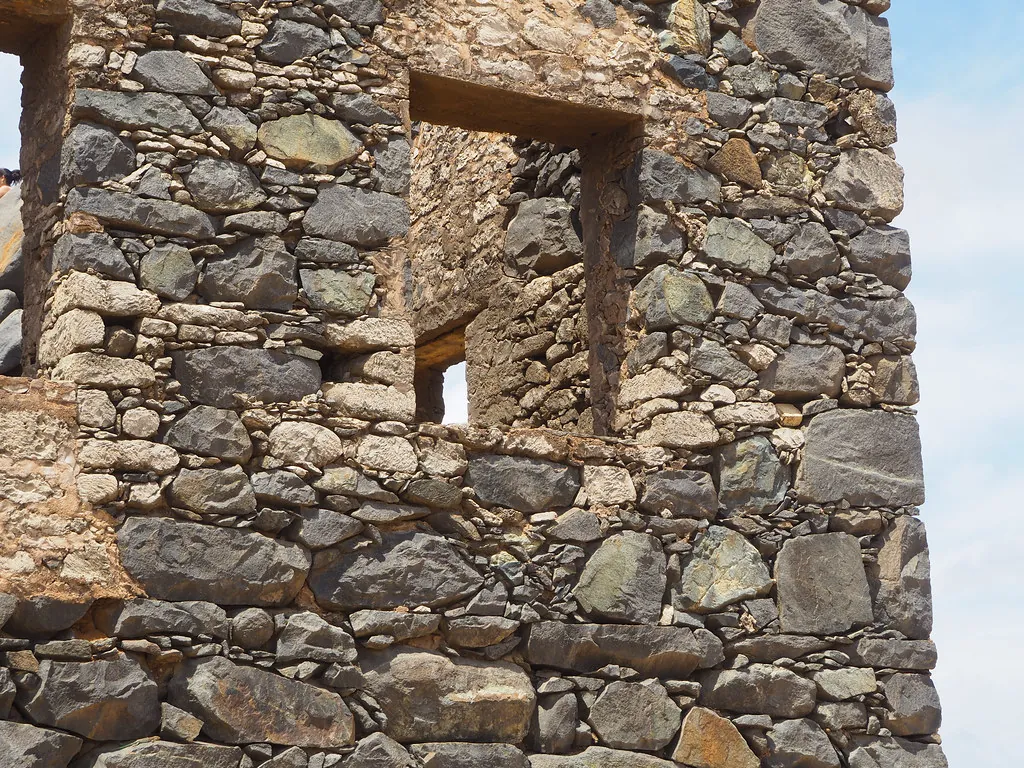
The Composition of “Caliche” Binding Agent
A common misconception is that Bushiribana is a “dry stone” construction. In reality, the massive limestone and volcanic blocks are bound by a primitive but incredibly durable mortar known as “caliche.” This local material was manufactured on-site by mixing calcium-carbonate-rich soil with burnt lime and seawater. Unlike modern Portland cement, which can become brittle and crack under constant salt exposure, caliche thrives in the arid, coastal environment of Aruba. It creates a breathable bond that allows for the natural expansion of the stone during the island’s intense daytime heat cycles.
“The use of local caliche allowed the structure to breathe, expanding and contracting with the intense heat of the Aruban sun without losing structural integrity.”
— Regional Engineering Analysis
- Chemical Resilience: The high alkaline content of the caliche neutralizes the acidic effects of salt spray.
- Local Integration: The material was sourced within a 2-mile radius, utilizing Aruban limestone and volcanic rock.
- Hardening: The mortar undergoes a carbonation process that increases its density over the span of decades.
Petrified Longevity: Over 150 Years of Chemical Hardening
Since its construction in 1872, the Bushiribana ruins have undergone a process of chemical petrification. The constant cycle of salt spray from the nearby Caribbean Sea and the baking UV radiation has caused the caliche mortar to mineralize. This has effectively fused the limestone blocks into a single, monolithic entity. This explains why the ruins remain standing while newer structures nearby have succumbed to the relentless Coastal Geology of the north shore. When you visit, you are not just looking at a pile of rocks; you are looking at a chemical reaction that has been hardening for over a century and a half.
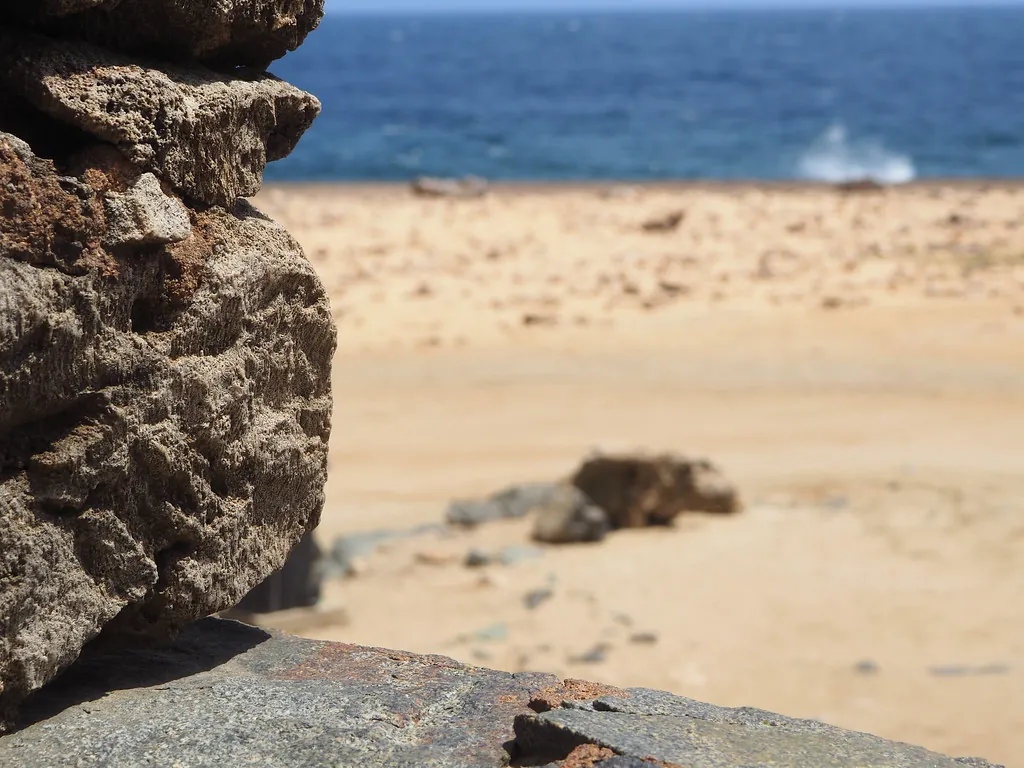
For those planning a visit to witness this architectural marvel firsthand, ensure you check our Essential Visitor Planning hub. The site is open 24/7 with no entrance fee, but the physical environment is unforgiving. Understanding the thermal properties of these stones makes it clear why the interior remains significantly hotter than the surrounding air during peak afternoon hours.
Cyclopean Masonry: The Logic of Irregularity
The mill utilizes a style known as “Cyclopean Masonry,” characterized by the use of massive, irregular limestone blocks fitted together with minimal mortar at the joints. In 1872, this was not an aesthetic choice but a practical one. Fitting irregular stones requires less precise cutting—a labor-intensive process—while providing superior stability against the vibrations of the heavy ore-crushing stamps. Furthermore, this “flexible” construction allowed the building to survive the intense thermal expansion caused by Aruba’s 90°F+ daytime heat. The gaps and irregularities provided a “flex mechanism” that prevented the walls from shearing under pressure.
Engineering for Security: Crenellations and Flues
The “fortress” look of Bushiribana was also influenced by the geopolitical realities of the 1870s. The jagged top edges of the walls, known as crenellations, were designed to provide cover for security personnel. During the peak of the gold rush, when the island processed over 3 million pounds of gold ore throughout its mining history, shipments were frequent targets for “maritime marauders” operating from the nearby coastlines. The architecture provided a defensible position for the company’s assets.
Additionally, looking closely at the upper masonry reveals deliberate vertical gaps. These were not cracks, but passive ventilation flues. They were designed to harness the constant Northeast Trade Winds to create a “venturi effect,” sucking toxic fumes and heat out of the building. This passive cooling system kept the interior habitable for laborers without the need for mechanical fans. To see these flues in person, a visit to the site is essential, often included in Things to Do & Sightseeing itineraries.
Explore the North Coast
The best way to appreciate the sheer scale of the limestone masonry is by approaching the site from the rugged coastal trails. Many visitors choose to combine their visit with other Nearby Attractions like the Natural Bridge or the Alto Vista Chapel. For those who prefer a guided experience to hear the technical history in person, several off-road tours provide access to this remote location. Most 4×4 rentals range from $180-$250 per day in 2026, while group UTV tours average $120-$160 per person.
Architectural FAQ
Why does the mill look like a fort?
The defensive appearance is a result of the double-wythe structural walls, which are 3-to-4 feet thick. These were designed to support heavy crushing machinery and provide a secure perimeter for gold processing operations in the 19th century.
What kind of stone was used in the construction of the ruins?
The majority of the site is built from local coralline limestone and volcanic rock (diorite) quarried from the immediate vicinity. These materials were chosen because their porous nature allows them to “breathe” and expel salt crystals, preventing structural failure from haloclasty.
Is the mortar still holding the stones together after 150 years?
Yes, the “caliche” mortar made from lime and seawater has undergone a process of chemical petrification. Over decades of exposure to the Aruban sun and salt spray, the mortar has mineralized, making the bond between the stones exceptionally strong today.
How did the Romanesque arches contribute to the building’s strength?
The iconic arched windows are true Romanesque apertures designed to distribute the immense weight of the upper stone blocks outward to the vertical pillars. This engineering choice prevented the relatively soft local limestone from cracking under its own massive weight.
How did they manage heat inside the smelting bays?
Engineers utilized the 15-25 knot trade winds by installing passive ventilation flues in the masonry. These gaps acted as natural vacuums, pulling heat and fumes out of the processing areas and keeping the structure from overheating during the smelting process.
Can the structure withstand the constant ocean spray?
The use of coralline limestone is specifically suited for this environment because its ancient coral skeleton structure is naturally porous. This allows the stone to expel salt crystals rather than letting them build up and shatter the rock, a common problem with imported, non-local building materials.