The Spark of 1824: Willem Rasmijn’s Accidental Discovery
The trajectory of Aruba’s economic history shifted irrevocably in 1824, not through a calculated geological survey, but via the keen eyes of a twelve-year-old boy. Willem Rasmijn was herding his father’s sheep through the desiccated hills of the island’s northern coast when he spotted a metallic glint in the dry bed of a creek. This wasn’t the dull luster of pyrite; it was a substantial nugget of high-purity gold. This singular moment ended Aruba’s era as a quiet pastoral outpost and ignited a fever that would eventually lead to the industrial monumentalism seen today at the Bushiribana Gold Mill Ruins.
Rasmijn’s discovery occurred in an area known as Rooi Fluit. At the time, the island was sparsely populated, and the northern coast was regarded as a formidable, wind-blasted territory unsuitable for anything other than hardy livestock. The news of the nugget spread with a speed that the colonial administration struggled to contain. Within weeks, the pastoral silence of the northern hills was replaced by the percussive sound of hand-tools striking quartz. This was the birth of the Aruban gold rush, a period of extraction that would eventually yield over 3 million pounds of gold ore for the island.
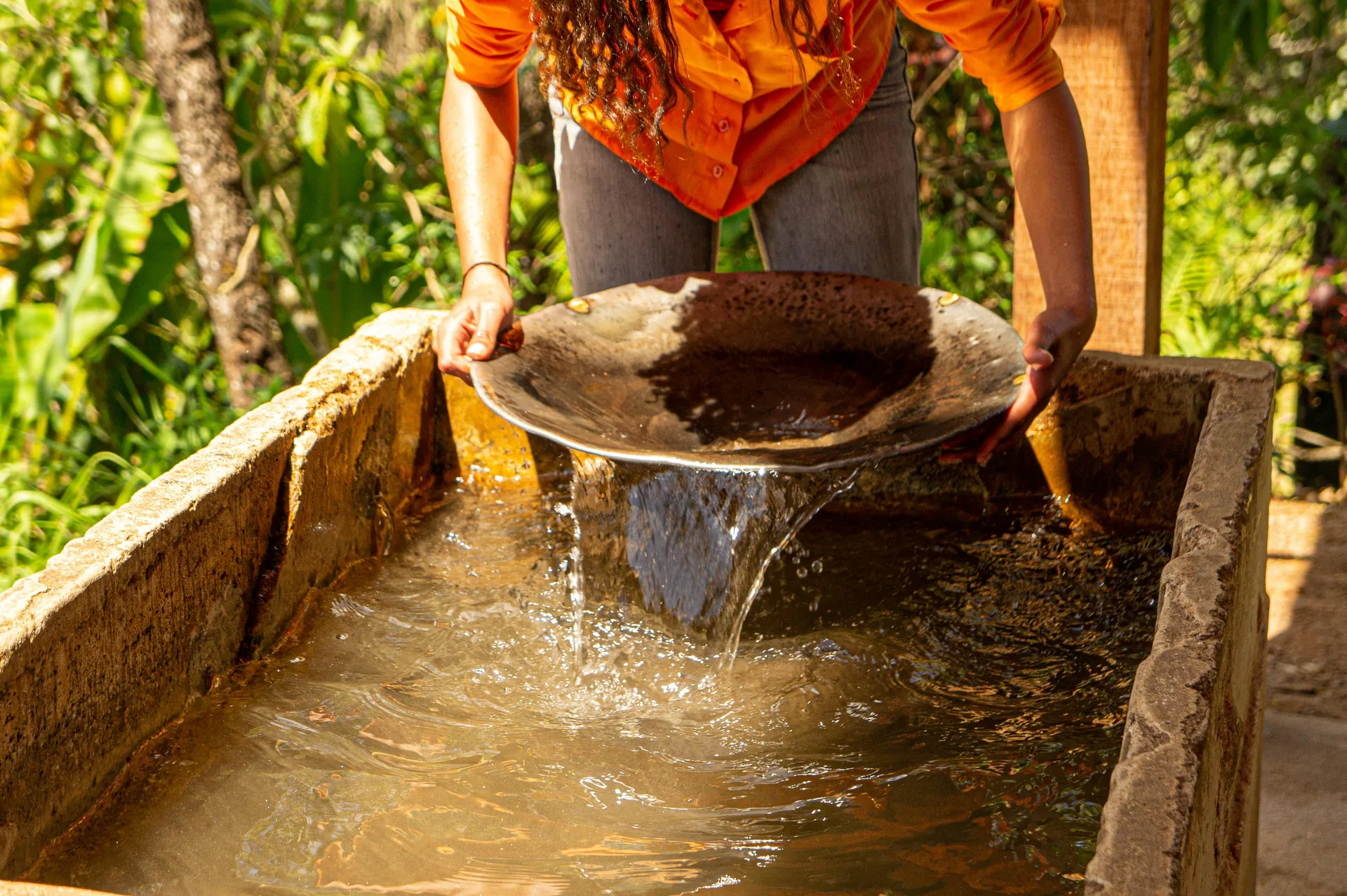
Rooi Fluit: The Golden Creek Bed and Geographic Context
To understand why the gold was there, one must look at the coastal geology of Aruba. The northern edge of the island is characterized by a complex intersection of volcanic base rock and ancient limestone terraces. Rooi Fluit, the site of the initial find, is a natural drainage channel that funnels rainwater from the higher elevations of the Ceru Plat hills toward the Caribbean Sea. Over millennia, the hydraulic action of seasonal rains eroded the gold-bearing quartz veins, depositing heavy alluvial gold into the creek bed’s sediment.
The immediate aftermath of Rasmijn’s find was a chaotic transition from a pastoral life to a prospecting economy. Local residents, many of whom had never seen gold in its raw form, abandoned their farms and livestock. The geography of the island dictated the pace of the rush; because the deposits were located in the rugged “north side,” the logistics of extraction required significant physical stamina. Prospectors had to contend with the relentless trade winds and the lack of potable water, factors that still influence how modern visitors should prepare their packing essentials for the trek to the ruins.
The “Free-for-All” Era (1824–1854)
For thirty years following the initial discovery, Aruba operated under a decentralized, small-scale mining system. The Dutch colonial government, recognizing the impossibility of policing the entire northern coast, established a “free-for-all” policy with one major caveat: the government was the sole legal buyer. Residents were permitted to mine the land using primitive methods—mostly pans and hand-picks—and were required to sell their findings to the Land’s Ontvanger (the local tax collector) at a fixed price.
- Fixed Pricing: The government set rates to ensure a steady flow into the colonial treasury while providing enough incentive for locals to continue the arduous work.
- Manual Extraction: Without heavy machinery, miners focused on “visible gold” found in alluvial deposits and shallow quartz veins.
- Economic Shift: This period saw the rise of a new merchant class in Oranjestad, as wealth from the northern hills began to circulate through the island’s primary port.
The Isaias Hellmund Concession and the Shift to Industry
The era of the individual prospector came to an end in 1854. As the easily accessible alluvial gold was depleted, it became clear that the real wealth lay deep within the quartz veins of Ceru Plat and Rooi Fluit. Extracting this gold required industrial-scale crushing and chemical processing, which was beyond the means of local residents. Isaias Hellmund, a shrewd entrepreneur, secured the first major mining concession from the Dutch authorities, effectively ending the “free-for-all” era and paving the way for international capital.
“The transition from the hand-pan to the stamp mill marked the moment Aruba entered the global industrial age. It was no longer about luck; it was about engineering and massive capital investment.”
— Historical Archive Analysis
The British Influx: Aruba Island Gold Mining Company Ltd.
Following Hellmund’s concession, the Aruba Island Gold Mining Company Ltd. was formed in London. This brought a surge of British capital, Cornish mining expertise, and heavy machinery to the island. The British engineers recognized that the decentralized mining of the past was inefficient. They sought to centralize the processing of ore from various shafts across the northern coast into one massive, state-of-the-art facility. This decision led to the construction of the Bushiribana works in 1872.
1872: The Birth of the Bushiribana Smelter
The construction of the Bushiribana smelter in 1872 was a logistical feat. The site was chosen for its strategic proximity to the most productive mining shafts and its position on the coast, which allowed the constant trade winds to dissipate the toxic fumes generated during the smelting process. During its peak years, Bushiribana was the “processing powerhouse” of the island, handling ore transported via mule carts from the nearby quartz veins. The facility was designed to handle the 3 million pounds of gold ore that would eventually be extracted from Aruban soil over the course of the century.
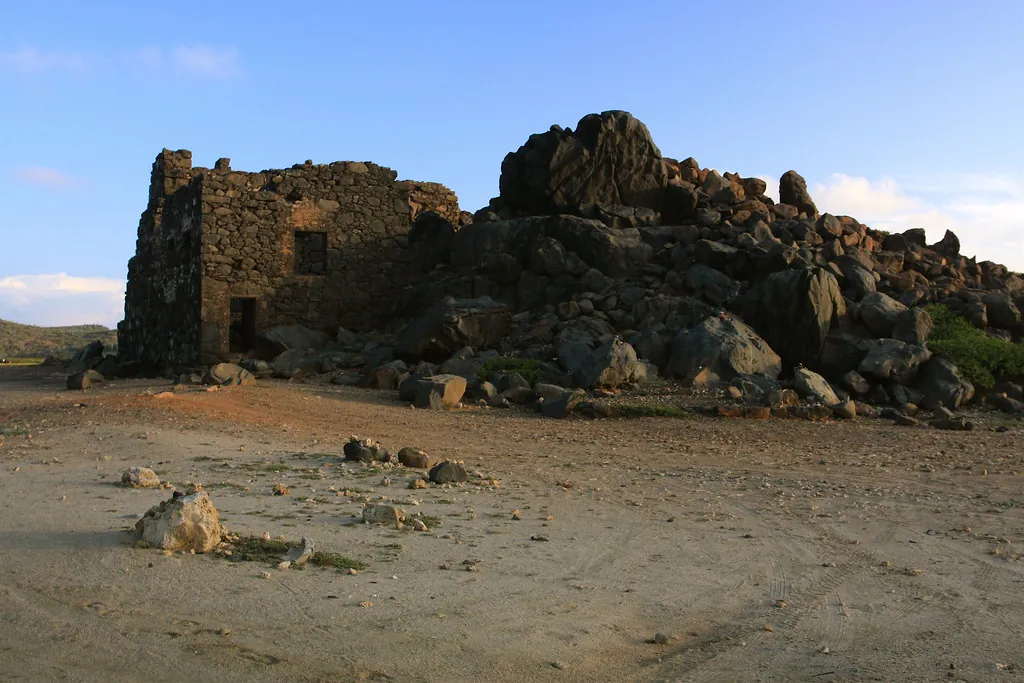
Fortress Architecture: Defensive Engineering of the 1870s
One of the most striking aspects of the ruins today is their architectural mastery. The mill was not built with aesthetics in mind, but rather security and durability. Constructed with massive, dry-stone limestone blocks, the facility resembles a medieval fortress. This design was a pragmatic response to the “Wild West” atmosphere of the Aruban north coast in the late 19th century. The thick, windowless lower walls and elevated entry points were specifically engineered to deter pirates and “wildcat” prospectors who might attempt to raid the mill for its gold concentrate or valuable mercury supplies.
The Walls: The limestone blocks were fitted together without mortar in many sections, relying on sheer mass and precise cutting to withstand the corrosive salt spray from the Atlantic.
The Chimneys: The remnants of high-reaching stone chimneys utilized a “venturi effect” to pull oxygen through the furnaces, reaching temperatures of 1,948°F.
The Technical Process: Mercury Amalgamation
The industrial process at Bushiribana was sophisticated for its time. Once the quartz ore arrived from Ceru Plat, it was fed into massive stamp mills—heavy iron pestles powered by steam engines—that crushed the rock into a fine powder. This powder was then subjected to the mercury amalgamation process. The crushed ore was mixed with liquid mercury; because gold has a high affinity for mercury, the two metals would bind together, forming an amalgam. This heavy mixture settled at the bottom of processing pans, while the lighter waste rock (tailings) was washed away.
The final stage involved heating the gold-mercury amalgam in the mill’s furnaces. The mercury would vaporize (often with disastrous health consequences for the workers), leaving behind pure gold bullion. The foundations you see when you visit the site today are the reinforced footings that once held these vibrating, multi-ton stamp mills in place. The sheer scale of the ruins provides a physical map of this 19th-century assembly line.
The 3 Million Pound Metric and Eventual Abandonment
While Bushiribana was a marvel of 1872 engineering, its reign was relatively short. By the late 1880s, the facility began to face challenges. The cost of importing coal to fire the furnaces was high, and the mercury amalgamation process, while effective, was not efficient enough to capture the microscopic gold particles found in lower-grade ore. Despite these hurdles, the collective output of the island’s mines during this era exceeded 3 million pounds of gold ore, a figure that remains a point of historical pride and a key driver of modern tourism to the site.
By 1899, a new, even more advanced facility was constructed at Balashi, near the Spanish Lagoon. This new mill utilized cyanide leaching, a process that could extract more gold from less ore. With the opening of Balashi, Bushiribana was mothballed. The “Stone Fortress” was left to the elements, beginning its slow transformation into the skeletal ruin that stands today, buffeted by the same trade winds that once cleared the smoke from its furnaces.
Essential Visitor Statistics
| Feature | Detail |
|---|---|
| Discovery Year | 1824 (Willem Rasmijn) |
| Construction Year | 1872 (Aruba Island Gold Mining Co.) |
| Entrance Fee (2026) | Free (No Ticket Required) |
| Opening Hours | 24/7 (Outdoor Landmark) |
| Transport Access | 4×4 or UTV Recommended (No Public Bus) |
| Total Island Yield | Over 3 Million Pounds of Gold Ore |
| Processing Method | Mercury Amalgamation & Stamp Milling |
| Primary Ore Source | Rooi Fluit & Ceru Plat Quartz Veins |
Frequently Asked Questions
How much gold was actually found in Aruba? Historical records and mining ledgers indicate that during the primary mining era between 1824 and the early 20th century, the island produced over 3 million pounds of gold ore. This ore was extracted from various locations, though the northern quartz veins were the most productive sources for the Bushiribana smelter.
Can I still find gold at the Bushiribana ruins today? While the prospect of finding a nugget is extremely low, the site remains a protected historical landmark where removing any stones or material is strictly prohibited. The “gold” found today is purely historical and photographic, as the industrial processes of the 19th century were thorough in extracting all viable bullion from the site.
Why does the mill look like a fort? The fortress-like appearance was a deliberate engineering choice to protect the valuable gold concentrate and mercury from the “Wild West” lawlessness of the north coast. The thick limestone walls and limited access points provided a defensive perimeter against unauthorized prospectors and potential raids.
Was the mining process dangerous for workers? Yes, the 19th-century mining and smelting process involved significant risks, including exposure to toxic mercury vapors and the physical dangers of working with heavy steam-powered stamp mills. The heat of the furnaces, combined with the intense Aruban sun, made the labor at Bushiribana some of the most grueling on the island.
Why was the mill eventually abandoned? Bushiribana was abandoned in favor of the Balashi Gold Smelter, which opened in 1899 and used the more efficient cyanide leaching process. The newer site also had better access to the water required for modern industrial gold extraction, making the mercury-based Bushiribana facility obsolete.
Explore the North Coast via Guided Adventure
While the history of the gold rush is best appreciated on foot among the ruins, reaching the site often requires specialized transport. Navigating the rugged trails from Oranjestad or the high-rise hotel district is a significant part of the experience. Many visitors choose to combine their historical exploration with visits to nearby attractions like the Natural Bridge or the Cave Pool, making for a full day of desert immersion.
For more information on planning your trip, including vehicle requirements and safety tips, visit our transportation guide or our essential visitor planning hub.